
Educational resource only. This site does not diagnose or treat any condition and makes no promises about results. Always speak with a doctor or physiotherapist about your own situation.
Men's Pelvic Fitness · Jakarta
Learn Kegel Exercises for Men at Your Own Pace
Plain instructions for pelvic floor training, breathing cues, and a routine that fits an ordinary week.
Jl. Kemang Raya No. 28, Jakarta Selatan · Mon–Fri, 9:00–18:00 WIB
This site is an educational resource about pelvic floor training for men in Indonesia. You will find plain instructions for Kegel exercises, notes on breathing, and simple ways to build a routine that fits an ordinary week. Nothing here replaces an assessment by a doctor or a physiotherapist, and we make no promises about results. What we can do is explain the movement clearly, describe common positions, and point out the mistakes that make practice harder than it needs to be.
What the muscle group does

What the pelvic floor actually does
The pelvic floor is a group of muscles that sits at the base of the pelvis, roughly between the pubic bone at the front and the tailbone at the back. In men these muscles wrap around the base of the bladder and the rectum, and they help hold urine and stool until you decide it is time to go. They also work during coughing, sneezing, and lifting, when pressure inside the abdomen rises suddenly. When people talk about bladder control or bowel control, they are usually talking about how well this group of muscles responds to that pressure.
Finding the right muscles
The most common instruction is to squeeze the muscles you would use to stop the flow of urine mid-stream. That cue is useful for discovery, and several men's Kegel guides use it for exactly that reason. It is not a training method. Guides consistently warn against practising by repeatedly stopping urine while you are actually urinating, because that habit can interfere with normal bladder emptying. Use the cue once or twice to locate the sensation, then practise away from the toilet.
Hold and release, not squeeze and clench
A rep has two halves. You tighten, hold briefly, then relax fully and let the muscles rest before the next one. Many resources describe slow, controlled reps as the standard format, and relaxation is treated as part of the routine rather than the pause between exercises. If you only practise the squeeze, you are training half the movement. Learning to let go completely is what makes the next repetition clean instead of a grind.
Breathing cues that keep it calm
Holding your breath during a contraction turns the exercise into a full-body strain, which is the opposite of what you want. A simple fix that appears in several guides is to count out loud while you hold. If you can speak, you are breathing. Slow counts also keep the pace honest, so you do not rush through reps to get them over with. This is one of the easiest details to get right and one of the easiest to forget.
A small routine you actually do beats an ambitious one you abandon
Consistency beats intensity. Pelvic floor muscles respond to regular, controlled practice, and they do not need to be exhausted. If you take one idea from this page, take that one.
Three positions, one progression
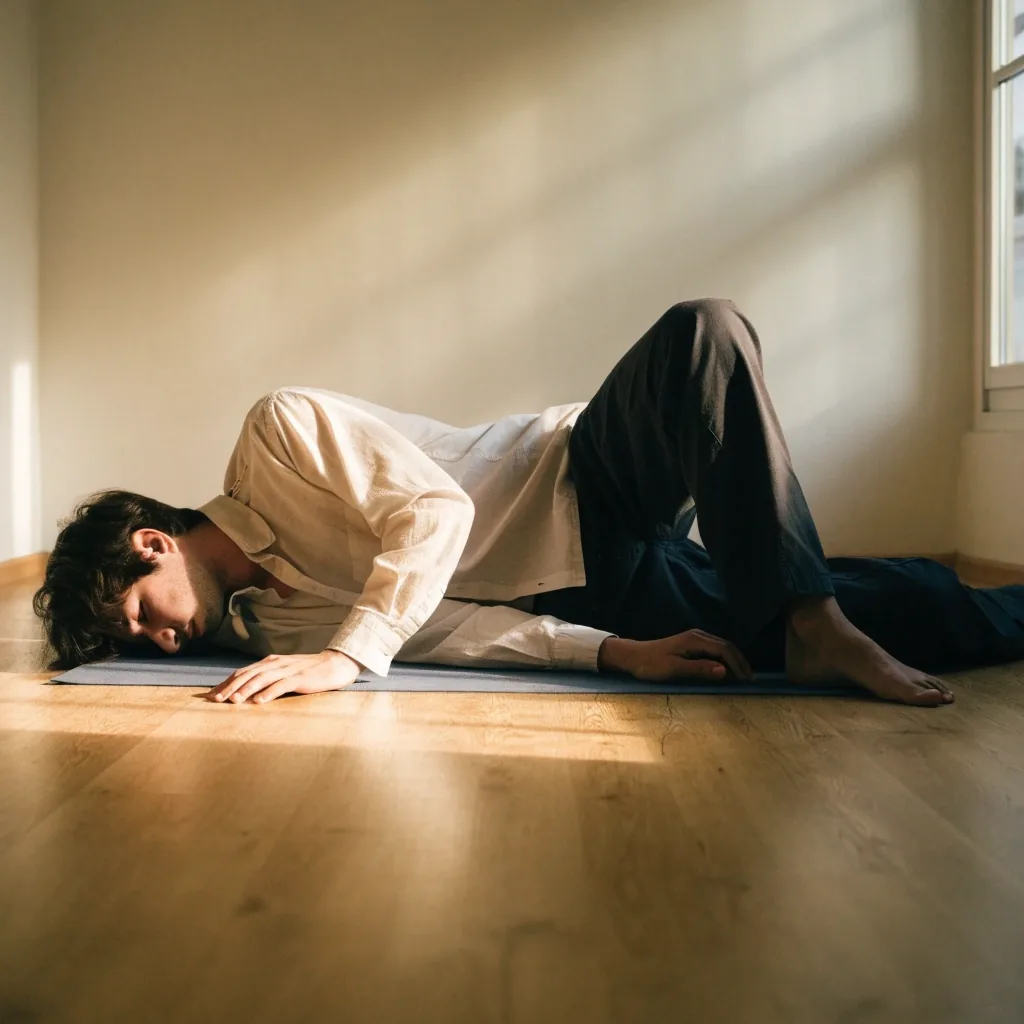
Lying down is where most beginners start, because it reduces the effort from other muscles while you learn the contraction. Seated practice comes next, and it is a good test of whether you can isolate the movement while your hips are doing something else. Standing is usually presented as a later step, and it is the position that translates most directly into daily life, since you are upright when you cough, lift, or wait in a queue. You can read a fuller comparison on our exercise positions page.

Why bladder control is the usual starting point
Bladder control appears again and again as the reason men begin pelvic floor training. The situations that come up most often are coughing, sneezing, lifting, and exertion, which are exactly the moments when abdominal pressure spikes and the pelvic floor has to respond. Bowel control gets mentioned alongside it in most health education material, and it is worth knowing that the same muscle group is involved. That is a supportive detail, not a promise that training changes anything for you personally.
What a realistic first week looks like
Keep it small. A short session of a few slow reps, done once or twice a day, is a common starting point in patient handouts, and it leaves room to add more later. Pick a trigger you already have, such as after brushing your teeth in the morning, so the routine does not depend on remembering to remember. If you feel yourself straining or holding your breath, stop the set and reset.
Build a weekly routineDays one to three
One short session, a few slow reps, lying down. The goal is only to find the sensation and confirm you can let go completely between reps.
Days four to five
Add a second short session, or repeat the first one seated. Keep counting out loud so the breath keeps moving and the pace stays honest.
Days six to seven
Rest one of the two days. Regular practice matters more than volume, and a rest day makes the next session easier to read.
If anything hurts
Stop the set, breathe normally, and restart with fewer reps or in an easier position. If pain continues, an assessment with a doctor or physiotherapist is the sensible next step.
Everyday habits that sit alongside training
Movement breaks during long sitting, drinking enough water across the day, and noticing how you hold your posture are all ordinary habits that men's wellness guidance tends to mention. None of them is dramatic. They matter because pelvic floor training happens inside a body that spends most of its day sitting, standing, and lifting, not in isolation.
Everyday male wellness habitsMovement breaks
Long hours in a chair keep the pelvic floor under steady, low-grade load. Standing up for a minute or two between tasks changes that load without needing a workout.
Water across the day
Drinking steadily rather than in one rush keeps bladder habits easier to read. It is also a plain reason to get up from the desk more often.
How you hold your posture
Noticing whether you brace, slouch, or tuck changes how the muscles at the base of the pelvis are being asked to work. The habit is observation, not correction.
Lifting without holding your breath
Lifting is one of the moments when pressure inside the abdomen spikes. Breathing out through the effort keeps the strain where it belongs instead of turning it into a hold.

When to check with a professional
If you have pain, if you are unsure whether the muscles are working the way you think, or if leakage is affecting your day, an assessment is the sensible next step. One men's pelvic health article from 2024 notes that Kegel exercises can have a place in discussions about pelvic floor pain and dysfunction, and it emphasises getting assessed first so the approach is appropriate for you. That framing is worth keeping: pelvic floor work belongs inside a broader plan when it belongs at all.
A note on what we do not claim
We do not promise that these exercises will fix anything, and we do not present them as a treatment. The material here describes a movement, the cues that make it easier to perform, and the habits that support consistency. Your results depend on factors we cannot see, which is why the site keeps pointing back to professional assessment when something is unclear or uncomfortable. That is the honest boundary of an educational resource.
How to use this site
Read in whatever order suits you; there is no sequence you have to follow. If the anatomy is new, start there. If you already know the movement, go straight to the routine.
Common questions
How do I find the correct muscles for Kegels without guessing?
Use the stop-the-urine-flow cue once to identify the sensation, then practise away from the toilet. Guides warn against repeatedly stopping urine mid-flow as a training method.
How many repetitions should a beginner do each day?
Patient handouts commonly start small, with a few slow reps once or twice a day, and build from there. Start lower than you think you need and add reps only when the movement feels controlled.
Should Kegels be done lying down, sitting, or standing?
Lying down is the usual starting position because it reduces effort from other muscles. Seated and standing practice are generally presented as progressions once the contraction is familiar.
How long before pelvic floor exercises feel natural?
There is no fixed timeline, and this site does not promise one. What most guides describe is that the movement becomes easier to locate and control with regular, relaxed practice.
Can I do these exercises without anyone noticing?
Yes. The contraction is internal, so seated and standing practice can be done quietly in ordinary settings. That is part of why standing practice is presented as a progression.
Should I pause the routine if I feel I am straining or holding my breath?
Yes. Stop the set, breathe normally, and restart with fewer reps or in an easier position. Counting out loud while you hold is a common cue for keeping the breath moving.
If your question is not covered here, see the full list of common questions or send us a question. We answer within our working hours, Monday to Friday, 9:00 AM – 6:00 PM WIB.
Where to go next
Start with the movement, then keep it small
Pick the guide that matches where you are now. If the anatomy is new, read the basics. If you are ready to practise, the Kegel routine is the step-by-step walkthrough.
Men's Pelvic Fitness · Jl. Kemang Raya No. 28, Jakarta Selatan · Mon–Fri, 9:00–18:00 WIB